How do I feel confident in the water with my baby?
Confidence in the water comes from a little rehearsal at home, a calm place and a plan you make before you go in. Here’s how nervous at the edge becomes easy in the water, one small win at a time.
Tammy Cohen Raz, founder 7 min read
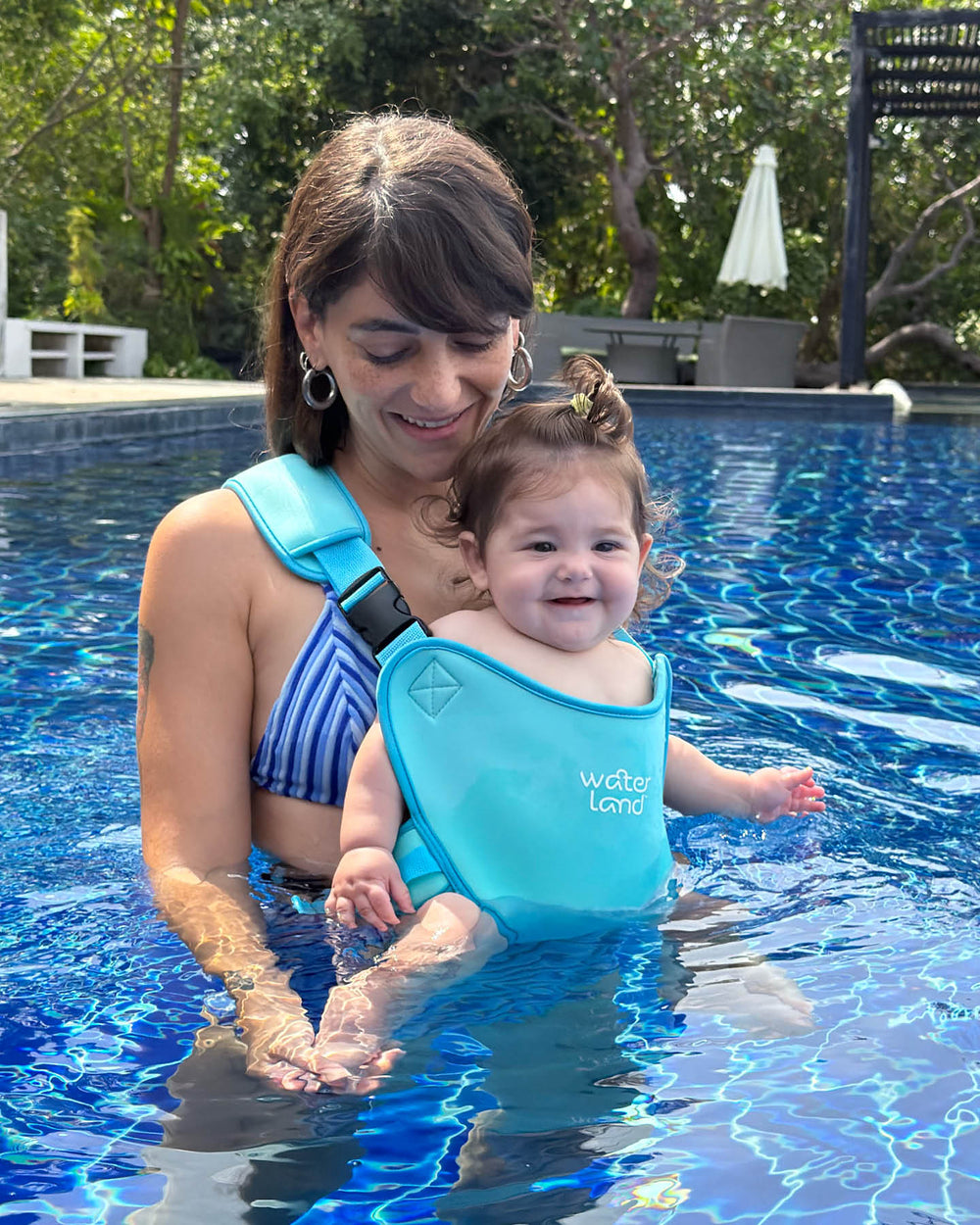
You’re standing at the edge of the pool with your baby on your chest. The water is bright and still, another family is laughing in the shallows, and part of you wants to step straight in while another part is quietly running through every awkward moment it can imagine. Then you go down the steps, the water settles warm around your waist, and a few minutes later your baby is patting the surface and looking up at you, delighted.
That short walk, from nervous at the edge to confident in the water, is what this article is about. Feeling nervous is common, and it says nothing about how good you’ll be at this. Confidence isn’t a feeling you wait for. It grows from what you know and what you’ve practiced, and the practice is simpler than it looks.
Where the nerves really come from
Ask a few parents what made them nervous and most won’t say “the water.” They’ll describe the juggling. A baby who is wet, wriggly and suddenly much harder to hold. Your own footing on a tiled step. The bag, the towels, the sunscreen, an older child who wants your attention, and the feeling that you should be watching everything at once. Many parents find it’s the number of things, more than any one of them, that makes the moment feel big.
That’s good news, because the number of things is something you can shrink. Every task you settle before you reach the water is one less task in the water. The rest of this article does exactly that: it practices what can be practiced, chooses the setting, makes the plan ahead of time and shares the load.
Rehearse it at home
Familiarity is where confidence starts, and you can build it on dry land. Before first use, try the carrier on without your baby, then adjust it to fit you both. Adjust it once, then it goes on like a T-shirt. Practice in your living room: put it on, place your baby in, and check three things every time. Face in view, chin off chest, close enough to kiss.
Then walk around the house together. Notice how your baby sits on your chest, how your arms move, how it feels to step up and down a stair with one hand on the rail. It sounds almost too simple, but the movements you’ve rehearsed are the ones you won’t have to think about later. That frees your attention for your baby, and for the fun.

Confidence is something you build, one calm, ordinary outing at a time.
Pick a calm place and time
Early outings go more easily somewhere calm. A quiet hour at a pool you know, with steps or a gentle slope and a rail to hold, asks far less of you than a crowded afternoon with loud music and constant splashing. Look for warm, still water and space around you. In the sea or a lake, go in only where the water is calm and flat, no deeper than your waist, with no breaking waves, at a lifeguarded spot where you can. If a wave, current or drop-off moves you or splashes your baby’s face, get out straight away.
Timing helps too. Many parents find a fed, rested baby is happier company in the water, and that they feel calmer themselves when nobody is rushing. Choose a time when no one needs to be anywhere next.
Make your plan before you go in
A plan made on dry land is the quiet engine of confidence, because it turns decisions into habits. Decide where you’ll stand: with both feet flat and firm on the bottom, no deeper than your waist, and with the water below your baby’s chest, whichever is shallower. Decide how you’ll get in and out: by the steps or a gentle slope, holding the rail. Decide how long you’ll stay. Short sessions keep it easy, and the steps at the end of this article suggest about 15 minutes to begin with.
Settle one more answer in advance, so you never have to think it through in the moment: if you slip or lose your footing, get your baby’s face clear of the water first, then get out and check your baby. Knowing your answer ahead of time is part of what lets you relax. And decide that the outing ends on a good note. If your baby falls asleep, or seems cold or too warm, you simply get out, and that still counts as a lovely session.
How supervision really works
Supervision near water is a specific skill, and understanding it is one of the most reassuring things you can learn. The American Academy of Pediatrics describes “touch supervision”: staying within arm’s length of a young child in the water. With your baby on your chest in a carrier, you’re already there. The habit to carry everywhere is the wider one: stay within arm’s reach of every young child in or near water.
When other children are with you, one adult is the water watcher: their only job is watching the children in the water, with no phone. If you’re the only adult, that’s you. The American Red Cross describes the role as close and constant attention, free of distractions including cell phones, and the AAP suggests watchers take turns, handing over every 15 to 20 minutes so attention stays fresh. The watcher keeps their eyes on the water rather than listening for a splash or a call, because, as the CDC notes, drowning can happen quickly and quietly.
This is also where a second adult makes a real difference. With two of you, one wears the baby while the other carries the bag, fetches the towel, watches the older children and takes the photos. Agree out loud who does what before anyone gets in. Shared jobs make each one lighter, and many parents say that’s the moment the nerves start to ease.
A carrier made for the water
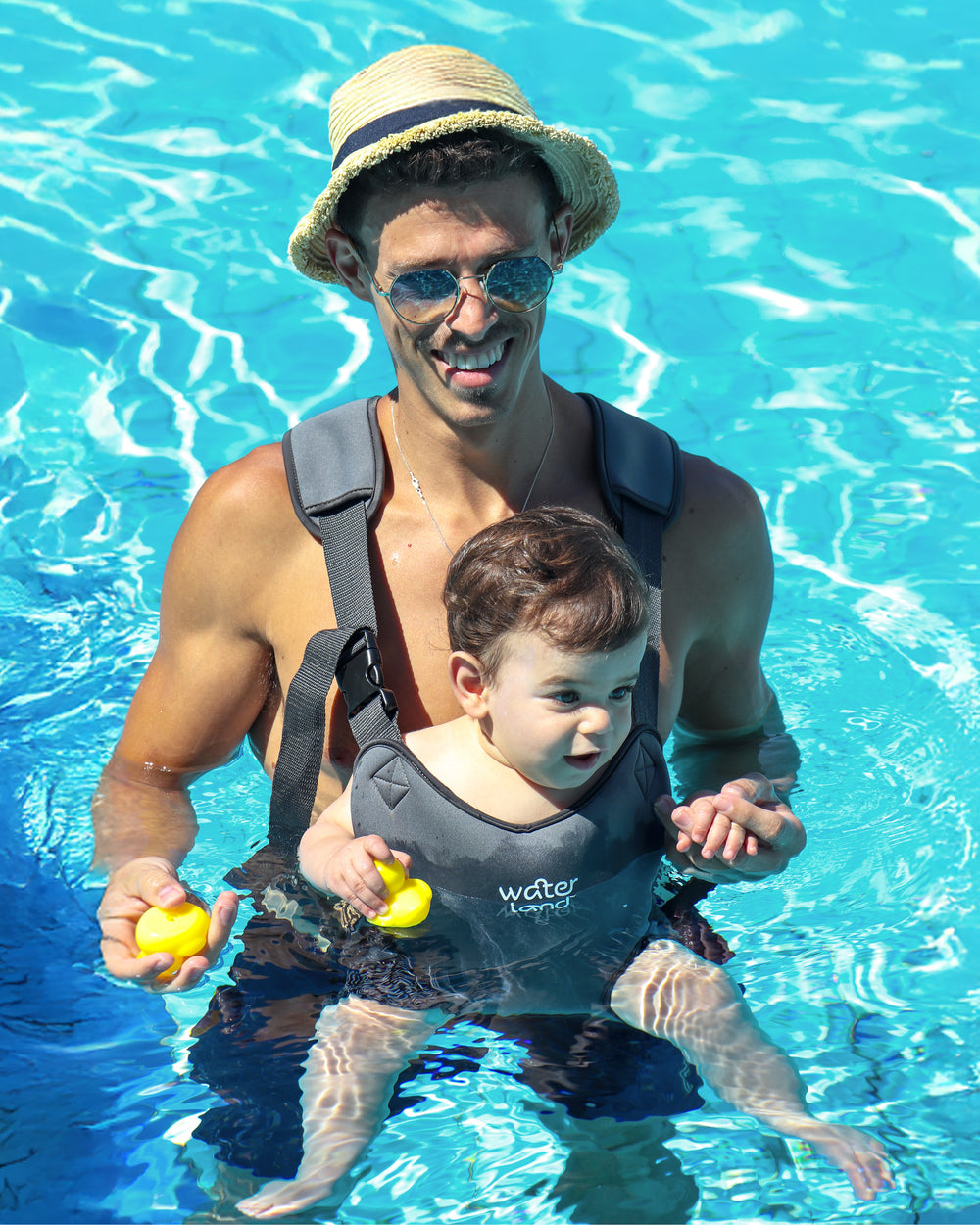
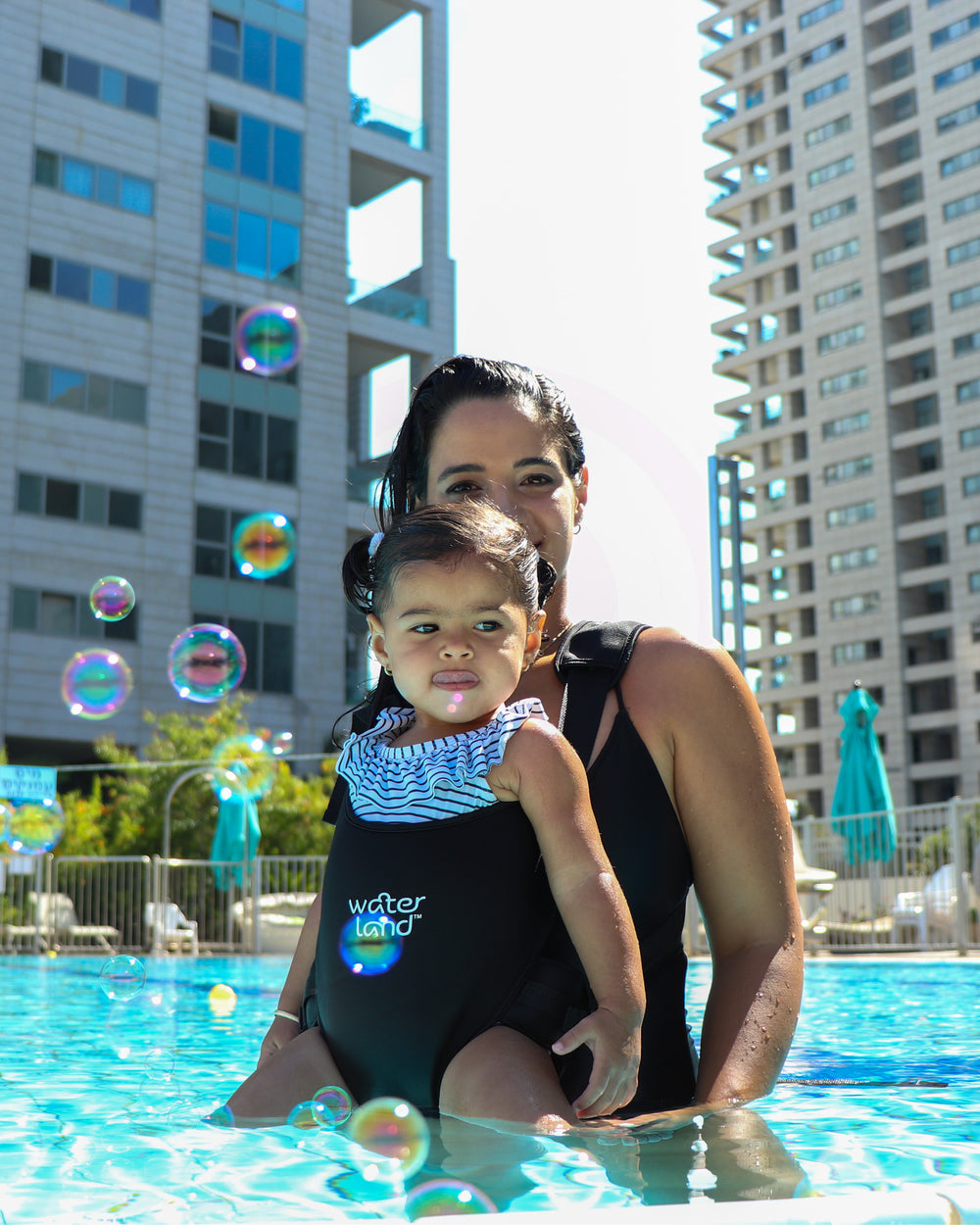
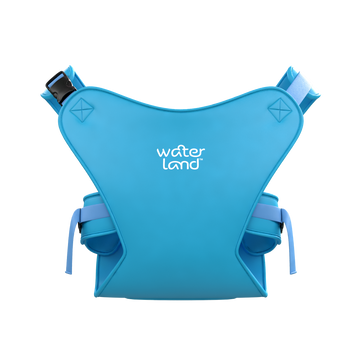
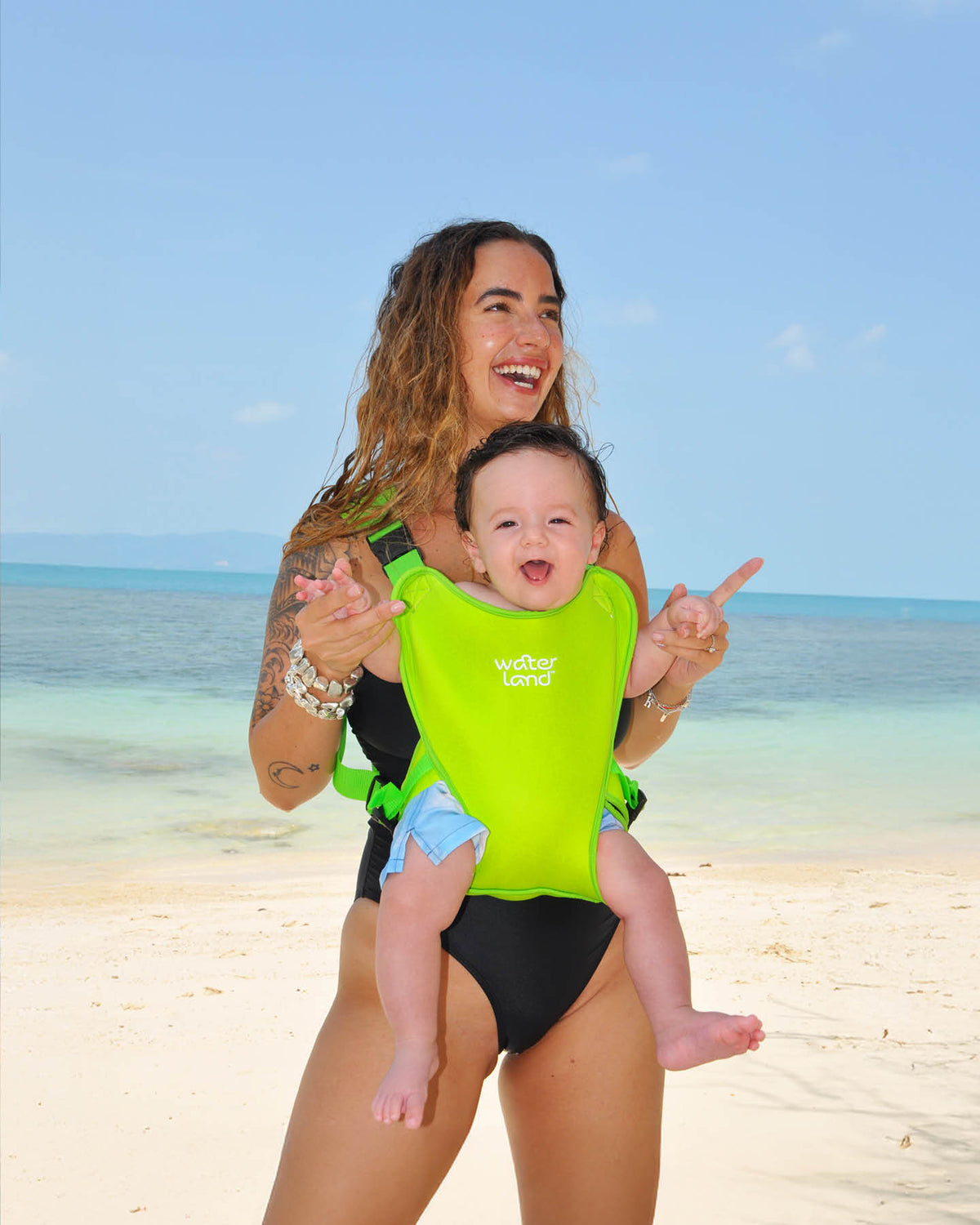
A carrier made for the water fits neatly into that plan. With WaterLand, your baby is on your chest, face in view, chin off chest, close enough to kiss, with their face well clear of the water. It’s made from soft neoprene, the material in wetsuits, which stays supportive when wet, then drains and dries, and its buckles and straps are made for water. WaterLand is safety-tested and meets the safety standards that apply to its intended use in water.
You wear it standing with both feet on the bottom, in calm water no deeper than your waist, keeping the water below your baby’s chest, whichever is shallower. It’s made for babies from about 4 months who hold their head steady without support, 13–33 lb (6–15 kg). What many parents notice most is simple: their baby is right there, close and calm, and the juggling has one less thing in it.
Small wins, repeated
It’s easy to put pressure on an outing: your baby should love it right away, you should stay longer, other parents look more at ease. Babies take to water in their own ways. Some smile at once, some watch quietly, and some mostly want to be held close. Every one of those is a good outing.
So measure success in small, repeatable wins. You got in calmly. You stood where you planned. Your baby looked around, or splashed, or simply rested against you. You got out before anyone was tired. Next time the same steps feel familiar, and familiar feels easy. Confidence is something you build, one calm, ordinary outing at a time.
Start tonight: try the carrier on at home, then pick a quiet hour this week at a pool you know. Go in together, and enjoy the view from the water.